Saturday, October 22, 2016

The Annis

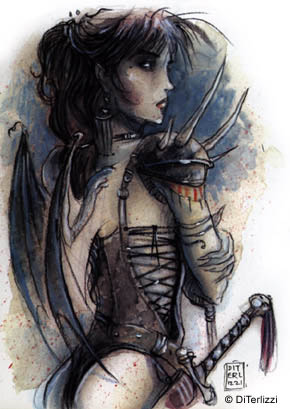
In addition to the green hag, night hag and sea hag, there was also the annis. She didn't make the cut for 5e for whatever reason. The annis is the physically largest and most direct of the hags. They also like to hang with ogres and trolls, perhaps a bit more than other hags.

Annis
Medium fey, neutral evil

Armor Class 17 (natural armor)
Hit Points 90 (12d8+36)
Speed 35 ft.

Str        Dex      Con      Int        Wis      Cha
19 (+4) 11 (+0) 16 (+3) 11 (+0) 12 (+1) 12 (+1)

Skills Deception +3, Perception +3, Stealth +2
Senses darkvision 60 ft., passive Perception 13
Languages Common, Giant
Challenge 3 (700 XP)

Innate Spellcasting. The hag’s innate spellcasting ability is Charisma (spell save DC 11). She can innately cast the following spells, requiring no material components:
3/day: fog cloud

Actions
Multiattack. The hag makes two attacks: one with her bite and one with her claws.

Bite. Melee Weapon Attack: +6 to hit, reach 5 ft., one target. Hit: 6 (1d6+4) piercing damage.

Claws. Melee Weapon Attack: +6 to hit, reach 5 ft., one target. Hit: 13 (2d8+4) slashing damage, and the target is grappled (escape DC 14).

Illusory Appearance. The hag covers herself and anything she is wearing or carrying with a magical illusion that makes her look like another creature of her general size and humanoid shape. The illusion ends if the hag takes a bonus action to end it or if she dies.
The changes wrought by this effect fail to hold up to physical inspection. For example, the hag could appear to have smooth skin, but someone touching her would feel her iron-hard flesh. Otherwise, a creature must take an action to visually inspect the illusion and succeed on a DC 18 Intelligence (Investigation) check to discern the hag is disguised.

The annis the largest and most physically imposing of the hags, standing 7 to 8 feet in height, and possessing deep blue skin that feels like iron. Hair, teeth, and nails are glossy black in color. The annis is typically much more direct than other types of hags, delighting in rending the flesh of her victims with her claws.

Joy in Cruelty
The greatest joy an annis can have is to inflict as much cruelty on another creature as possible. To hear the wail of anguish of a loved one while she slaughters a victim is delightful music to her ears.

Covens
An annis that is part of a coven has a challenge rating of 5 (1,800 XP).

Wednesday, October 19, 2016

Half-ogre PC race.

Half-ogres seem to be all the rage lately, so this is my take on it. I tried to come up with something a little different than the half-orc or goliath, while attempting to keep it competitive. Let me know what you think.

Half-Ogre
A half-ogre is a crossbreed between a human and an ogre, distinct from an ogrillon, which is the result of a union between an orc and an ogre. This interbreeding is almost never, if ever, a happy thing. A half-ogre raised by a human community will typically find himself mistrusted, possibly pitied, and sometimes outright hated by his neighbors. A half-ogre raised by his ogre kin will be looked down on until he has proven himself in battle.

As one might expect, a half-ogre is typically very large and very strong. They are bigger and somewhat more bestial in appearance than a half-orc, with skin tones ranging from pale yellow to dull brown, or even occasionally grey. Warts are common, and a half-ogre’s hair is usually dark-colored. Eyes are usually human-like, though some half-ogres are born with the black eyes of their ogre lineage.

Runts of the Tribe
Ogres look upon these half-breeds as small and weak compared to a full-fledged ogre. Until a half-ogre has a chance to prove himself in battle, he will be pushed around by his full-blooded kin. Once he manages to show the rest of the tribe his fury in combat, he will gradually gain respect. It’s not unusual for a half-ogre to be smarter than his tribemates, and it’s not entirely unheard of for a half-ogre to work his way into a position of leadership. Ogres led by a half-ogre will tend to fight with a surprising amount of strategy and tactics, rather than behave like an unruly, chaotic mob which is how ogres usually fight.

Mistrusted Outcasts
A half-ogre raised in a human community will find it extremely difficult to find acceptance amongst his human kin. Many will fear and mistrust him, due to both his size and bestial appearance. Others will outright hate him, if for no other reason than that the half-ogre is a constant reminder of a tragic chapter in the community’s past. The half-ogre learns to be a solitary survivor, untrusting of those around him.

People generally view a half-ogre as big, strong and stupid, with impulse and anger control issues. Some half-ogres can be surprisingly intelligent, though, and are commonly underestimated. The one group that a half-ogre can expect to find acceptance from is the half-orcs, who experience some of the same issues in human society. And the one line of work a half-ogre is always welcome is one that involves inflicting violence.

Half-Ogre Names
A half-ogre raised by ogres will have an ogre type of name, usually something short, simple, and harsh sounding. A half-ogre raised by humans will have a name typical for that community.

Half-Ogre Traits

Boosted Ability Score. Your Strength score increases by 2 and your Constitution score increases by 1.

Age. Half-ogres have lifespans comparable to humans. They reach adulthood in their mid teens and don’t usually live longer than a century.

Alignment. Regardless of where they are brought up, half-ogres tend more towards chaotic than not. A half-ogre raised among ogres will almost certainly be evil, while one raised by humans will not usually be terribly inclined towards good.

Size. Half-ogres are between 7 and 8 feet tall, and weigh between 300 and 400 pounds. Your size is medium.

Speed. Your base walking speed is 30 feet.

Darkvision. Your ogre blood gives you superior vision in dark and dim lighting conditions. You can see in dim light within 60 feet of you as if it were bright light, and in darkness as if it were dim light. You can’t discern color in darkness, only shades of grey.

Large and Threatening. You gain proficiency in the Intimidation skill.

Powerful Build. You count as one size larger when determining your carrying capacity and the weight you can push, drag, or lift.

Ogre Toughness. Your hit point maximum increases by 1, and it increases by 1 every time you gain a level.


Languages. You speak, read, and write Common and Giant. Half-ogres raised by an ogre tribe are rarely literate and may not know Common.

Based on feedback, I've dropped the speed to 30 ft and added the note about literacy if the half-ogre is raised in an ogre tribe.

Wednesday, September 28, 2016

The daughters of Graz'zt

Graz'zt apparently has a fairly large number of children, shocking I know. Many of you know about Iuz, the demigod and apple of his daddy's eye. I posted Rule-of-Three, another son, not that long ago. Today, I'm going to cover two of his daughters: Thraxxia, his personal assassin, and Belyara, a really obscure daughter who is currently having some daddy issues.

I'll be covering Athux, Graz'zt's son and general of his armies, soon.


Thraxxia
Medium fiend, chaotic evil

Armor Class 20
Hit Points 168 (16d8+96)
Speed 30 ft., fly 50 ft.

Str        Dex      Con      Int        Wis      Cha
21 (+5) 18 (+4) 22 (+6) 17 (+3) 16 (+3) 22 (+6)

Saves Con +10, Int +7, Wis +7, Cha +10
Skills Arcana +7, Deception +10, Intimidation +10, Perception +7, Stealth +8
Damage Resistances cold, fire, lightning; bludgeoning, piercing, and slashing from nonmagical weapons
Damage Immunities poison
Condition Immunities poisoned
Senses truesight 120 ft., passive Perception 17
Languages Abyssal, Common, Infernal
Challenge 12 (8,400 XP)

Fiendish Blessing. Thraxxia’s AC includes her Charisma Bonus.

Innate Spellcasting. Thraxxia’s spellcasting ability is Charisma (spell save DC 18). Thraxxia can innately cast the following spells, requiring no material components:
3/day: alter self, command, detect magic
1/day: plane shift (self only)

Magic Resistance. Thraxxia has advantage on saving throws against spells and other magical effects.

Spellcasting. Thraxxia is an 11th level spellcaster. Her spellcasting ability is Charisma (spell save DC 18, +10 to hit with spell attacks). Thraxxia knows the following sorcerer spells:
Cantrips (at-will): dancing lights, fire bolt, mage hand, prestidigitation, shocking grasp. truestrike
1st level (4 slots): false life, shield, sleep
2nd level (3 slots): detect thoughts, mirror image
3rd level (3 slots): counterspell, dispel magic, haste
4th level (3 slots): dimension door. greater invisibility
5th level (2 slots): dominate person
6th level (1 slot): disintegrate

Surprise Attack. If Thraxxia surprises a creature and hits it with an attack during the first round of combat, the target takes an extra 10 (3d6) damage from the attack.

Actions
Multiattack. Thraxxia makes two melee attacks.

Claw. Melee Weapon Attack: +9 to hit, reach 5 ft., one target. Hit: 8 (1d6+5) slashing damage plus 10 (3d6) necrotic damage.

Horror Nimbus (Recharge 5-6). Thraxxia magically emits scintillating, multicolored light. Each creature within 15 feet of her that can see the light must succeed on a DC 18 Wisdom saving throw or be frightened for 1 minute. A creature can repeat the saving throw at the end of each of its turns, ending the effect on itself on a success. If the creature’s saving throw is successful or the effect ends for it, the creature is immune to Thraxxia’s Horror Nimbus for the next 24 hours.

Teleport. Thraxxia magically teleports, along with any equipment she is wearing or carrying, up to 120 feet to an unoccupied space she can see.

Thraxxia is one of Graz’zt’s many daughters, her mother a long-dead mortal human. Thraxxia serves as Graz’zt’s personal assassin, and to date she has yet to fail in a mission given to her. To prove her worth to her father, she murdered three of her half-sisters. Thraxxia is vindictive and spiteful, traits that Graz’zt has nurtured in his beautiful daughter.


Thraxxia appears as a beautiful young woman, with long, dark hair and a cruel mien. A pair of small horns grows from her forehead, while a pair of somewhat smallish leathery wings sprouts from her back. Her gaze is sharp and predatory, and when she smiles or snarls, sharp teeth are revealed. Thraxxia’s small, shapely form is deceptively strong, containing the strength and power of a nalfeshnee, abilities she gained through treachery, wit and guile. Thraxxia frequently makes use of a variety of magical items when she is on the hunt.


Belyara
Large fiend (shapechanger), chaotic evil

Armor Class 20 (natural armor)
Hit Points 171 (18d10+72)
Speed 30 ft., swim 30 ft.

Str        Dex      Con      Int        Wis      Cha
20 (+5) 16 (+3) 18 (+4) 17 (+3) 17 (+3) 20 (+5)

Saving Throws Str +9, Con +8, Int +7, Cha +9
Skills Arcana +7, Deception +13, Insight +7, Perception +7, Stealth +7
Damage Resistances cold, fire, lightning, poison; bludgeoning, piercing, and slashing from nonmagical weapons
Senses darkvision 60 ft., passive Perception 17
Languages Abyssal, Common, Infernal
Challenge 10 (5,900 XP)

Fiendish Blessing. Belyara’s AC includes her Charisma bonus.

Innate Spellcasting. Belyara’s innate spellcasting ability is Charisma (spell save DC 17). She can innately cast the following spells, requiring no material components.
At will: disguise self (any humanoid form), major image
3/day: charm person, detect magic, mirror image, scrying, suggestion
1/day: geas, plane shift (self only)

Limited Shapeshifting. Belyara can use her action to change her lower half into normal human limbs, assuming a wholly human form. She reverts to her true form if she dies.

Spellcasting. Belyara is a 10th level spellcaster. Her spellcasting ability is Charisma (spell save DC 17, +9 to hit with spell attacks). Belyara knows the following sorcerer spells:
Cantrips (at-will): dancing lights, fire bolt, friends, mage hand, minor illusion, shocking grasp
1st level (4 slots): color spray, shield. sleep
2nd level (3 slots): detect thoughts, hold person
3rd level (3 slots): counterspell, dispel magic, haste
4th level (3 slots): confusion, dimension door
5th level (2 slots): dominate person

Actions
Multiattack. Belyara makes three attacks: one with her longsword and one with her intoxicating touch or two with her longsword, and one with her tail.

Intoxicating Touch. Melee Spell Attack: +9 to hit, reach 5 ft., one target. Hit: The target is magically cursed for 1 hour. Until the curse ends, the target has disadvantage on Wisdom saving throws and all ability checks.

Longsword. Melee Weapon Attack: +9 to hit, reach 5 ft., one target. Hit: 9 (1d8+5) slashing damage, or 10 (1d10+5) slashing damage if used with two hands.

Tail. Melee Weapon Attack: +9 to hit, reach 10 ft., one target. Hit: 14 (2d8+5) bludgeoning damage. If the target is Medium or smaller, it is grappled (escape DC 17). Until the grapple ends, the target is restrained, Belyara can automatically hit the target with her tail, and Belyara can’t make tail attacks against another target.

Acid Spit. Ranged Weapon Attack: +7 to hit, range 20 ft., one target. Hit: 7 (2d6) acid damage.

Belyara is one of the demon lord Graz’zt’s more obscure children. Until relatively recently, she was the prisoner of a powerful eladrin conjuror. It is uncertain how long she was a prisoner, and it is unknown how she escaped. What is known, however, is that she is extremely angry with her father, and now she seeks revenge against him for allowing her to languish for so long. It remains to be seen what form this revenge will take.

Belyara’s mother is a lamia noble, and she has inherited a number of abilities from her mother, such as her limited shapeshifting ability and many of her innate spellcasting abilities. Like a lamia noble, Belyara looks like an extremely beautiful dark-complexioned woman, with lustrous black hair and an intoxicating smile. Her lower body, however, consists of the muscular coils of a serpent. Her eyes are piercing and inhuman, golden in color, with the slitted pupils of a venomous snake. Like her lamia mother, she likes to adorn herself in finery whenever she can.

Belyara is prone to wanton behavior, not unlike both of her parents. She has also displayed the violent outbursts that lamia nobles are known for.

Sunday, September 25, 2016

Warduke, the baddest man in the whole damn town.

My first encounter with Warduke was his action figure, way back in 1983. He looked cool, even if his armor seemed impractical. He then appeared in Quest for the Heartstone as a pregenerated character, followed by The Shady Dragon Inn, with goals that were about as impractical as his armor. Somewhere in there he made an appearance in the Dungeons & Dragons animated series, where he captured Dungeon Master.

The last time I saw him was in Dungeon Magazine #105, where he was given stats updated to 3.5. Here, he was firmly placed in the World of Greyhawk, where he was a member of the Horned Society. After 591 CY, Warduke is a high ranking member of the Society, and a general menace to everyone. You can read about this here: Canonfire: The Horned Society

Here we have Warduke's Wikipedia page: Warduke

The Power Score Blog and Hack & Slash both have nice little retrospectives on the character.

Anyway, here is my 5e take on the character. I took the somewhat unusual step of giving him a full player character class, namely the Battle Master Fighter.


Art by Wayne Reynolds, of course.

Warduke
Medium humanoid (human), lawful evil

Armor Class 18 (adamantine half plate, spellguard shield)
Hit Points 175 (18d10+72)
Speed 30 ft.

Str        Dex      Con      Int        Wis      Cha
20 (+5) 13 (+1) 18 (+4) 11 (+0) 13 (+1) 14 (+2)

Saving Throws Str +11, Con +10
Skills Athletics +11, History +6, Intimidation +8, Persuasion +8, Survival +7
Other Proficiencies Dragonchess, Smith’s tools
Senses darkvision 60 ft., passive Perception 11
Languages Abyssal, Common, Infernal
Challenge 13 (10,000 XP)

Action Surge. On his turn, Warduke can take one additional action on top of his regular action and possible bonus action. Warduke may use this ability twice, then must finish a short or long rest before he can use this ability again.

Battle Master. Warduke has 6 superiority dice, which are d12s. Warduke knows the following maneuvers (save DC 19): disarming attack, lunging attack, maneuvering attack, menacing attack, parry, precision attack, riposte, sweeping attack, trip attack

Fighting Style. Warduke has the Dueling fighting style, granting a +2 bonus to damage rolls if he is wielding a weapon in one hand and isn’t wielding any other weapons.

Indomitable. Warduke can reroll a saving throw he fails. He must accept the new roll. He may use this ability three times between long rests.

Know Your Enemy. If Warduke spends at least 1 minute observing or interacting with another creature outside of combat, he can learn certain information about its capabilities compared to his own. See page 74 of the Player’s Handbook for specifics.

Relentless. When Warduke rolls initiative, if he has no superiority dice, he regains 1 die.

Second Wind. On Warduke’s turn, he can use a bonus action to regain 1d10+18 hit points. He must finish a short or long rest before he can use this ability again.

Actions
Multiattack. Warduke makes three attacks.

Flame Tongue Longsword. Melee Weapon Attack: +12 to hit, reach 5 ft., one target. Hit: 12 (1d8+8) slashing damage plus 7 (2d6) fire damage if used with one hand, or 11 (1d10+6) slashing damage plus 7 (2d6) fire damage if used with two hands.

Dagger. Melee Weapon Attack: +12 to hit, reach 5 ft., one target. Hit: 10 (1d4+8) piercing damage.

Equipment
Adamantine Half Plate. Warduke’s adamantine half plate armor is made from, you guessed it, adamantine. While he is wearing it, any critical hits against him become normal hits.

Dagger of Venom. Warduke typically only uses this weapon for assassinations, rather than open combat. It has +1 to attack and damage rolls. Warduke may use an action to cause thick, black poison to coat the blade. The poison lasts for 1 minute or until an attack using this weapon hits a creature. The creature must succeed on a DC 15 Constitution saving throw or take 11 (2d10) poison damage and become poisoned for 1 minute. The dagger can’t be used this way again until the next dawn.

Nightwind. Nightwind is Warduke’s Flametongue longsword. It has +1 to attack and damage rolls. Warduke may use a bonus action to speak Nightwind’s command word, causing flames to erupt from the blade. These flames shed bright light in a 40-foot radius and dim light for an additional 40 feet. When the sword is ablaze, it deals an extra 7 (2d6) fire damage to any target it hits. The flames last until Warduke uses a bonus action to speak the command word again or until he drops or sheathes the sword.

Spellguard Shield. While holding this shield, Warduke has advantage on saving throws against spells and other magical effects, and spell attacks have disadvantage against him.

Warduke’s Helm
Wondrous item, very rare (requires attunement)

This bat-winged helm has three rubies mounted on the faceplate and shrouds the wearer’s face in shadow, making it all but impossible to see it.  The only thing that can be seen from within the helm is the wearer’s eyes, which glow a baleful red. Wearing the helm confers the following benefits:

·         Darkvision 60 ft.

·         Advantage on Charisma (Intimidate) checks.

·         The central ruby acts as a ring of spell storing, able to store up to 6 levels worth of spells at a time. It functions exactly the same as a ring of spell storing.


Warduke usually has a word of recall spell stored in the gem.

Friday, September 23, 2016

Rule-of-Three, one of the many sons of Graz'zt.

Rule-of-Three is one of the many Planescape characters out there. I gather he hasn't made many appearances, but he was in Expedition to the Demonweb Pits (which I happen to have a copy of). He is the son of Graz'zt, and his ultimate goal is the unite the three major fiendish races of the lower planes and crush the upper planes.

He poses as a githzerai sage, using his abilities to disguise his appearance in public. He dispenses cryptic advice from the Styx Oarsman, which is a tavern & rooming house in the Lower Ward of the city of Sigil. Most people in Sigil are not aware that he is actually a cambion and the son of the demon lord Graz'zt.


Rule-of-Three
Medium fiend, chaotic evil

Armor Class 22 (studded leather)
Hit Points 105 (14d8+42)
Speed 30 ft.

Str        Dex      Con      Int        Wis      Cha
18 (+4) 18 (+4) 16 (+3) 17 (+3) 14 (+2) 20 (+5)

Saving Throws Str +7, Con +6, Int +6, Cha +8
Skills Arcana +6, Deception +8, History +6, Perception +5, Persuasion +8, Stealth +7
Damage Resistances cold, fire, lightning, poison; bludgeoning, piercing, and slashing from nonmagical weapons
Senses darkvision 60 ft., passive Perception 15
Languages Abyssal, Common, Infernal
Challenge 7 (2,900 XP)

Abyssal Expertise. Rule-of-Three’s proficiency modifier is doubled for Intelligence (Arcana) or (History) checks related to the Abyss. For these checks, he has Arcana +9 & History +9.

Fiendish Blessing. Rule-of-Three’s AC includes his Charisma bonus.

Innate Spellcasting. Rule-of-Three’s spellcasting ability is Charisma (spell save DC 16). Rule-of-Three can innately cast the following spells, requiring no material components:
3/day: alter self, command, detect magic
1/day: plane shift (self only)

Sneak Attack. Once per turn, Rule-of-Three can deal an extra 10 (3d6) to one creature he hits if he had advantage on the attack roll. He must use a finesse or ranged weapon.

He doesn’t need advantage on the attack roll if another enemy of the target is within 5 feet of it, that enemy isn’t incapacitated, and Rule-of-Three doesn’t have disadvantage on the attack roll.

Rule-of-Three also doesn’t need advantage on the attack roll if no creature other than his target is within 5 feet of him.

Actions
Multiattack. Rule-of-Three makes two melee attacks or uses his Eldritch Ray twice.

Dagger. Melee or Ranged Weapon Attack: +8 to hit, reach 5 ft. or range 20/60 ft., one target. Hit: 7 (1d4+5) piercing damage.

Eldritch Ray. Ranged Spell Attack: +7 to hit, range 120 ft., one target. Hit: 10 (3d6) force damage.

Fiendish Charm. One humanoid Rule-of-Three can see within 30 feet of him must succeed on a DC 16 Wisdom saving throw or be magically charmed for 1 day. The charmed target obeys Rule-of-Three’s spoken commands. If the target suffers any harm from Rule-of-Three or another creature or receives a suicidal command from Rule-of-Three, the target can repeat the saving throw, ending the effect on itself on a success. If a target’s saving throw is successful, or if the effect ends for it, the creature is immune to Rule-of-Three’s Fiendish Charm for the next 24 hours.

Equipment
Dagger of Venom. You gain a +1 bonus to attack and damage rolls made with this magic weapon.
You can use an action to cause thick, black poison to coat the blade. The poison remains for 1 minute or until an attack using this weapon hits a creature. That creature must succeed on a DC 15 Constitution saving throw or take 2d10 poison damage and become poisoned for 1 minute. The dagger can't be used this way again until the next dawn.

Glamoured Studded Leather. While wearing this armor, you gain a +1 bonus to AC. You can also use a bonus action to speak the armor's command word and cause the armor to assume the appearance of a normal set of clothing or some other kind of armor. You decide what it looks like, including color, style, and accessories, but the armor retains its normal bulk and weight. The illusory appearance lasts until you use this property again or remove the armor.

Eyes of Seeing. These crystal lenses fit over the eyes. They have 3 charges. As an action, you can speak the lenses' command word and expend 1 charge. For the next 10 minutes, you have truesight out to 120 feet when you peer through the lenses.

The lenses regain 1d3 expended charges daily at dawn.

Ring of Mind Shielding. While wearing this ring, you are immune to magic that allows other creatures to read your thoughts, determine whether you are lying, know your alignment, or know your creature type. Creatures can telepathically communicate with you only if you allow it.

You can use an action to cause the ring to become invisible until you use another action to make it visible, until you remove the ring, or until you die.


If you die while wearing the ring, your soul enters it, unless it already houses a soul. You can remain in the ring or depart for the afterlife. As long as your soul is in the ring, you can telepathically communicate with any creature wearing it. A wearer can't prevent this telepathic communication.

Wednesday, September 21, 2016

Blackscale and Poison Dusk Lizardfolk

 The D&D 3.5 Monster Manual III saw the coming of the Blackscale Lizardfolk and the Poison Dusk Lizardfolk. One of them is big and smashy, the other is small and sneaky. I gather that they're both relatively prominent in the Eberron setting, which I don't know a lot about. I will say, though, that from what I have seen & heard, Eberron is pretty awesome. It seems I missed a few awesome things when I took a little hiatus from playing D&D.

Note: both pictures below are from the Monster Manual III.


Lizardfolk, Blackscale
Large humanoid (lizardfolk), neutral

Armor Class 14 (natural armor)
Hit Points 59 (7d10+21)
Speed 40 ft., swim 30 ft.

Str        Dex      Con      Int        Wis      Cha
19 (+4) 10 (+0) 16 (+3) 7 (-2)   12 (+1) 7 (-2)

Skills Perception +3, Stealth +2, Survival +5
Damage Resistances acid
Senses passive Perception 13
Languages Draconic
Challenge 3

Hold Breath. The blackscale lizardfolk can hold its breath for 15 minutes.

Actions
Multiattack. The blackscale lizardfolk makes two attacks, each one with a different weapon.

Bite. Melee Weapon Attack: +6 to hit, reach 5 ft., one target. Hit: 8 (1d8+4) piercing damage.

Greatclub. Melee Weapon Attack: +6 to hit, reach 5 ft., one target. Hit: 13 (2d8+4) bludgeoning damage.

Javelin. Melee or Ranged Weapon Attack: +6 to hit, reach 5 ft. or range 30/120 ft., one target. Hit: 11 (2d6+4) piercing damage.


Like the common lizardfolk, blackscale lizardfolk are primitive reptilian humanoids that lurk in the world’s swamps and jungles. Their lairs are typically very similar to the common lizardfolk’s lairs: hut villages in grottos, marshy ruins, and watery caverns.

Blackscale lizardfolk are usually around 9 feet tall, with black scales. A leathery crest runs from the top of its head to about mid-back, and its deep-socketed eyes and flat nasal openings give its face an appearance similar to a skull.

These creatures are every bit as territorial and xenophobic as their smaller kin. They tend to be more straightforward combatants, finding tricks and traps tools for lesser lizardfolk. Blackscale lizardfolk are overly concerned with showing their battle prowess, and will fight as an unruly mob if left to their own devices. It takes a strong hand to get them organized for any length of time.


Lizardfolk, Poison Dusk
Small humanoid (lizardfolk), neutral

Armor Class 14 (natural armor)
Hit Points 13 (3d6+3)
Speed 25 ft., swim 25 ft.

Str        Dex      Con      Int        Wis      Cha
12 (+1) 15 (+2) 12 (+1) 8 (-1)   12 (+1) 7 (-2)

Skills Perception +3, Stealth +6, Survival +5
Senses passive Perception 13
Languages Draconic
Challenge 1/2

Chameleon Skin. The poison dusk lizardfolk have advantage on Dexterity (Stealth) checks.

Hold Breath. The poison dusk lizardfolk can hold its breath for 15 minutes.

Poison Use. The poison dusk lizardfolk frequently makes use of poison, and it is considered proficient with the Poisoner’s Kit.

Actions
Multiattack. The poison dusk lizardfolk makes two attacks, each one with a different weapon.

Bite. Melee Weapon Attack: +4 to hit, reach 5 ft., one target. Hit: 4 (1d4+2) piercing damage.

Shortbow. Ranged Weapon Attack: +4 to hit, range 80/320 ft., one target. Hit: 5 (1d6+2) piercing damage, and the target must make a DC 11 Constitution saving throw, taking 10 (3d6) poison damage on a failed save, half as much on a successful one.

Net. Ranged Weapon Attack: +4 to hit, range 5/15 ft., one target. Hit: Special: target creature of Large size or smaller is restrained until it is freed. A creature can use its action to make a DC 10 Strength check, freeing itself on a success. Dealing 5 points of slashing damage to the net (AC 10) also frees the creature without harming it, ending the effect and destroying the net.

Scimitar. Melee Weapon Attack: +4 to hit, reach 5 ft., one target. Hit: 5 (1d6+2) slashing damage.


The poison dusk lizardfolk, standing between 3 & 4 feet tall, are considerably smaller than their other lizardfolk kin, but they are no less dangerous when provoked. A poison dusk lizardfolk’s scales can shift in color, which happens frequently to reflect the lizardfolk’s mood. They are also able to use their ability to change color to give them an advantage when hunting or in battle. Its eyes are larger than other species, and its crest flattens or extends based on mood.

Poison dusk lizardfolk are much more cunning than their larger kin, preferring to strike at their foes through trickery rather than direct combat. They make frequent use of traps and poison, and favor ambushes. One of their favorite tactics is to entangle foes with nets, then have archers strike with poison arrows.